The Slow Story
A lesson in slowing down and in delayed gratification

From the time the kids were born, I made sure to include a library of baby-appropriate books, because that’s what a first-time mother would do: to fill the nursery with the “must-haves”, from high contrast books to classics by Mem Fox and Eric Carle, to touching stories like Love You Forever, I had them all.
I wanted reading to become a part of our family life and routine. The kids would always bring books over to us to read during play time. They would even spend a lot of time just flipping through picture books on their own, before they could read. And of course, they love our bedtime routine as we cuddled close together reading Guess How Much I Love You. We would have read 10-15 books to the kids every single day.
Then around 2024, I started teaching Ari how to read. We started reading little books that I would make up, that consisted of simple sight words and CVC words. Eventually, she caught on to the Gerald and Piggie series that really spearheaded her reading journey.
There came a time in 2025, where I recall myself saying aloud (amidst all the chaos of homeschooling and trying to run my household), asking Ari to go and read on her own, since she could read now. It wasn’t long before I realized that I shouldn’t have done that, and I went back to reading to her as much as she would read independently.
If you had asked me why I made reading such a big deal in our house, I would probably just say that reading is a good habit, and that it was great for building language skills. But recently, I had the time to really reflect and find out why. And it’s changed how I think about books entirely, as one of the best things we can offer our kids right now.
The world they’re growing up in
The default environment for children today is built around instant reward. The dopamine hit is fast, frequent and designed to be that way. Dopamine pathways that get repeatedly activated by fast stimuli start expecting fast stimuli, and over time, waiting begins to feel boring and intolerable.
If you think about it, books are the opposite of this. A chapter book doesn’t resolve in a sitting. A good story withholds, makes you wonder, and makes you wait. I think that patience is a practiced trait, by building it through low-stakes experiences (like reading), and having the tolerance of the not-knowing and the unresolved. Children who read long-form fiction are practicing that. Younger children can also benefit from this as we read one chapter each night before bed. “Another chapter pleaseeeeee Mama?”, they are likely to say. And I reply, “We’ll have to wait until tomorrow to find out. I can’t wait to read it with you.”
As I thought about it further, the long term benefits of practicing delayed gratification (and reading is only one of many low-stakes ways) will benefit them in future through impulse control.
As my kids get older, I’m thinking about how and why I want to continue reading aloud. And then I got researching, about how a child’s reading level and their listening level are not the same thing. The gap between what a child can read and what a child can comprehend is enormous, and reading aloud is the bridge. It means that when we read a richer, more complex story aloud to our children, we’re not just sharing a nice bedtime ritual. We’re actively expanding the vocabulary, information, and emotional landscape, years before they could access it independently.
The listening level gap
Children have to hear a word many times before they can say it easily, and hear it in context many times before they can use it with understanding. Spoken language is the foundation that reading builds on, not the other way around. The more words a child hears (good literature, not TikTok speak), the more words they have to draw from when they speak, write, and think. So many times, when Ari is reading out loud to me (another practice that I think is important for early readers and to build public speaking skills), I am surprised that she could actually read a complicated word that phonetically makes no sense to her at this stage. Then I realized that it is because she has heard it, in context, in story, in real life, over and over again, that when it appears in a sentence or a storyline, it is only natural for it to roll off her tongue!
What good writing gives them that a screen doesn’t
There’s a particular quality to the language in children’s literature and even picture books that is hard to find anywhere else in a child’s daily life. Luminous. Ravenous. Melancholy. Cacophony. Rambunctious.
There’s something deeper happening here other than developing greater vocabulary - a child’s internal life gets richer when they have more precise language for it. The ability to name an emotion, a texture, a quality of light, a feeling they couldn’t previously articulate… that comes from literature. Paced character development does something else again. A character who changes across 150 pages, who makes mistakes and recovers, who fears something and faces it slowly - that gives a child a picture of how growth actually works.
Why we still read aloud
I was listening to a podcast by Meghan Cox Gurdon, author of The Enchanted Hour. She describes reading aloud as one of the fastest-acting antidotes to the fractured attention spans and disconnection that characterise the tech era. It’s a shared space and experience that builds memories, warmth and connection. I never want to stop sitting next to my kids and reading together. I think it’s so unfortunate to just say to kids, “Oh you’re too old for these picture books now, you go along and read your own big kids books.” I think picture books have so many beautiful stories, with messages that will live with them for a long time to come. Perhaps they enjoy their chapter books as ‘their thing’, but we revisit their old childhood favorites, over and over as an ‘our thing’. Either way, I will not stop reading to my child.
It starts with me
I was an avid reader as a child. But almost as soon as I got out of school, I don’t think I’ve ever picked up a book again to read. Magazines, articles yes, but not a book. When I met my husband 10 years ago and went on our first holiday together, I brought along a book, The Omnivore’s Dilemma by Michael Pollan. I started reading the book, and the joke 10 years on is that I’m still reading it. But one year ago, in 2025, I decided that there was so much that I’m missing out on by not reading, and I had begun feeling the impacts of fast-media that I wanted an analog practice, to slow down and challenge myself to do something that was difficult for me to focus on. I don’t think I’m alone in this — many women that I’ve spoken to also share the same challenge. We know that reading is beneficial, but somehow there is a huge hurdle to overcome. For many parents, exhaustion and a lack of time is a major one.
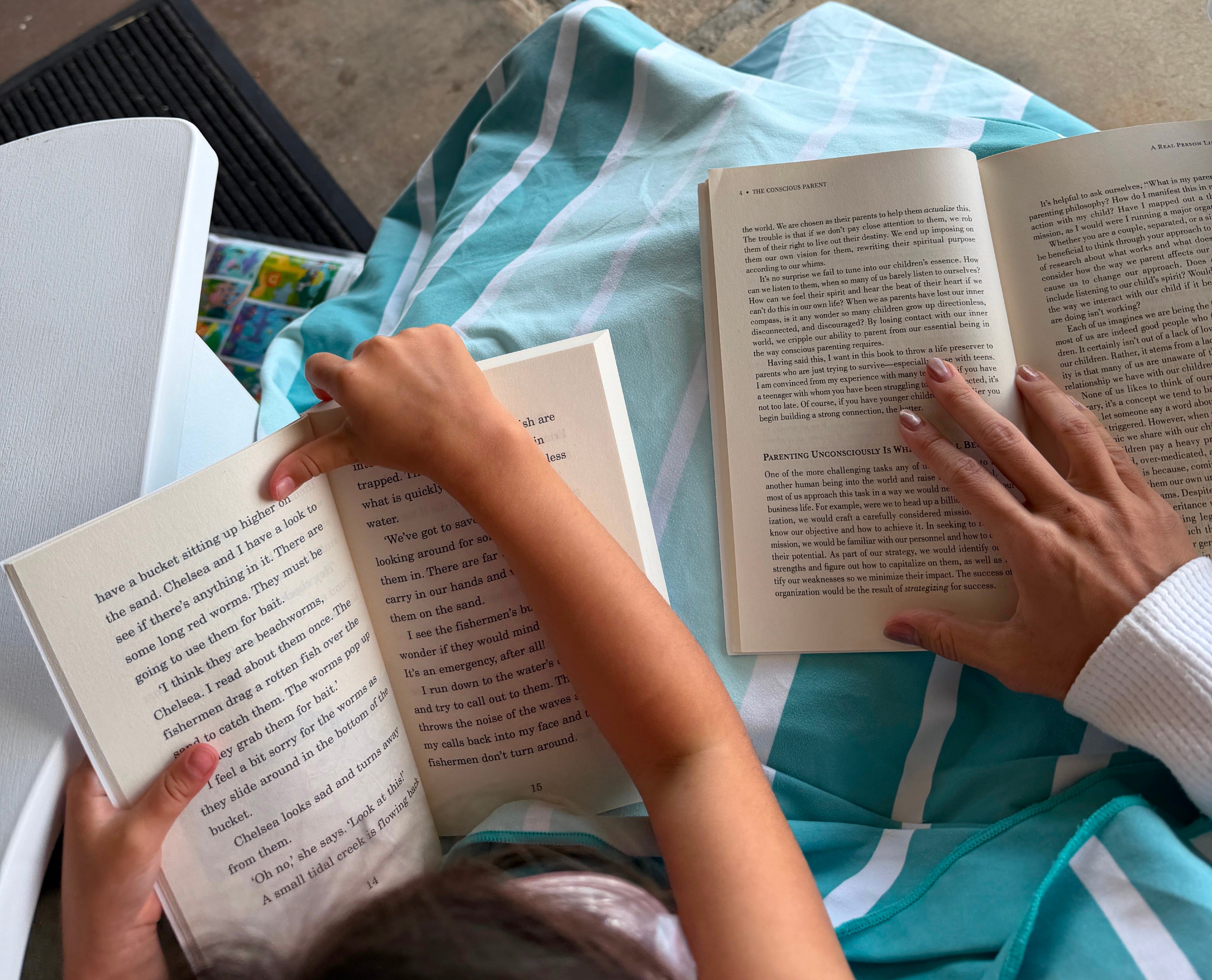
I finally read my first book in decades in Feb 2025 and went on to read a modest 4 other books through the year. I realized too, that if I wanted reading to be in our family DNA, that I had to first model it. Me choosing to sit with a book (not a podcast that I can multi-task to, not a Netflix episode I can half watch), is choosing to be somewhere fully.
Reading, I’ve come to think, is less about literacy (though it builds that too) and more about a relationship with time. It teaches children that some things are worth waiting for, and that a story gets better the longer you stay in it.